The PEG Commission’s scope must include

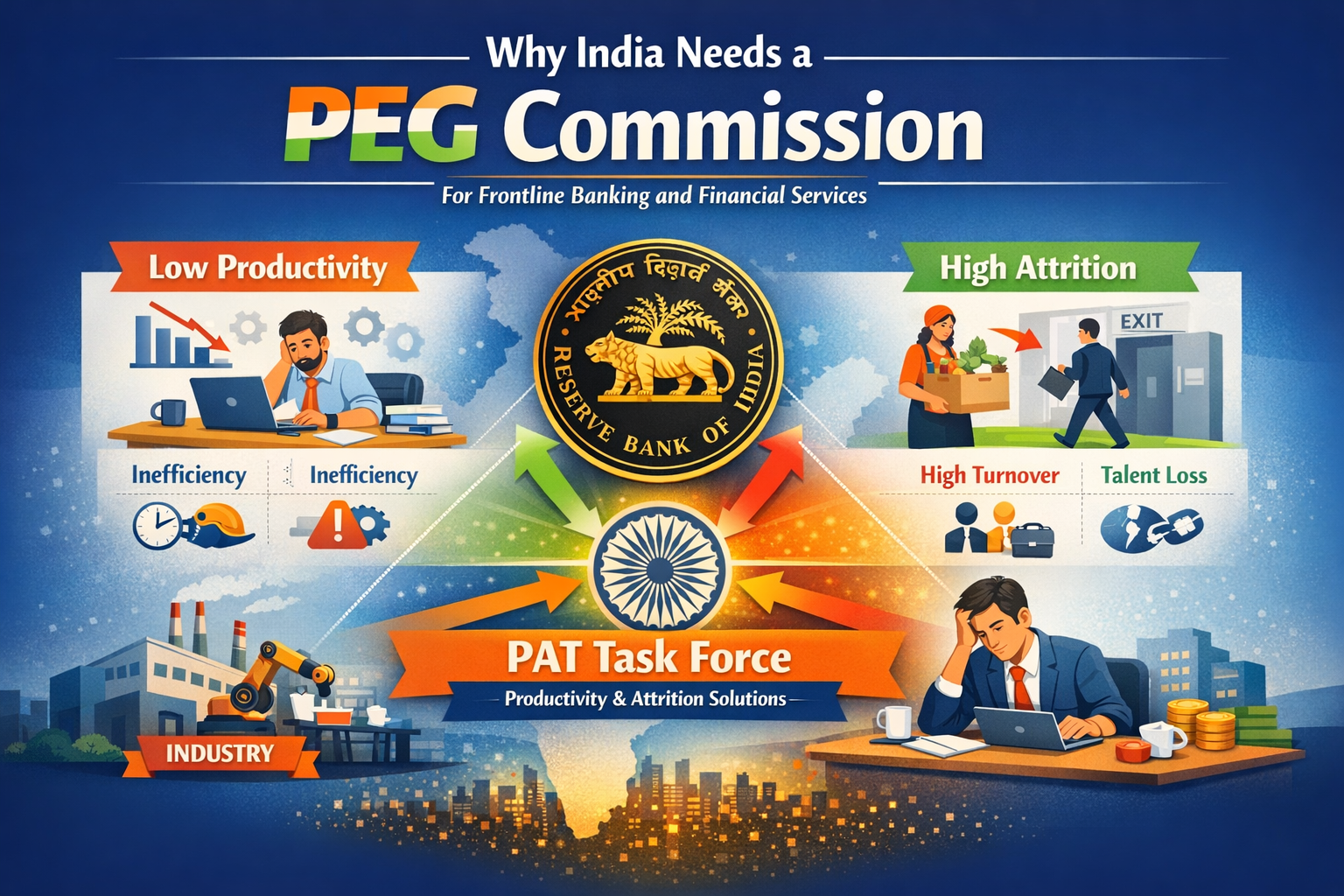
Why India Needs a PEG Commission
India can no longer rely solely on cheap labour or consumption to remain competitive. The only sustainable path is through productivity-led growth, paired with new employment creation. This is why India urgently needs a Commission for Productivity and Employment Growth (PEG).
Such a commission would be statutory and independent, with a mandate not only to measure productivity but also to link it with employment creation, incentives for industry, and technology adoption. Unlike the National Productivity Council and State Councils, which have remained largely advisory and ineffective, this new body would be empowered to recommend sectoral reforms, incentive frameworks, and interventions for the AI-driven future of work.
Global experiences reinforce the urgency: Australia, New Zealand, and Japan all treat productivity as a top national agenda, with Australia even hosting a three-day national productivity conference in August 2025. India risks falling behind if it does not act quickly
The PEG Commission’s scope must include:
- Measuring and benchmarking productivity across sectors
- Mapping global competitiveness and identifying priority sectors for India
- Recommending fiscal and policy incentives for industry to adopt productivity-enhancing technology
- Driving MSME technology adoption through zero-interest loans and targeted support
- Preparing the workforce for AI disruptions, recommending re-skilling and job transition programs
- Linking productivity reforms directly to employment creation and higher wages
India’s demographic peak, wage trap, and Skill Mission challenges underscore the urgency. Productivity is not a threat to jobs in India — it is the only way to raise incomes and create better-paying, sustainable employment. A Commission for Productivity and New Employment Creation will be the bridge between demographics, technology, and inclusive growth.
Part 1: Why India Needs a PEG COMMISSION. Now.
Let me start with a live and contemporary story From August19 to 21, 2025, the Australian government conducted a high-level Economic Reform Roundtable in Canberra, capital of Australia, with productivity as the core agenda.. The roundtable was designed to guide the next three federal budgets and long-term policy settings.
The event brought together about 50 influential participants, including business leaders, union representatives, senior bureaucrats, economists, and academics. Among them were CEOs from major corporates, Banks, alongside union heads and members of the Australian Productivity Commission.
The summit established a collaborative framework for reform, with Cabinet to take final calls and step-by-step measures to boost productivity, modernise the economy, and sustain competitiveness in an uncertain global landscape.
This is how a small economy like Australia is responding to current challenges Indian economy is at an inflection point.
With tariff wars, trade nationalism, and technological disruption, India’s traditional growth levers—cheap labour and a large domestic market—will not be enough. We have to become more export competitive and withstand global imports
Why a PEG Commission?
- Fragmented efforts: India has multiple agencies—NITI Aayog, ministries, state planning boards—that work on reforms, but none has a singular mandate to track, analyse and own the national productivity agenda.
- Stagnant productivity: India’s labour productivity growth peaked in the mid-2000s (reaching around 4.5% during 2008–2016), but the long-term average across recent decades hovers near 4.3%, with no sign of acceleration.
- Structural mismatch: 42% of Indian workers are in agriculture which contributes only 15% of GDP. Moving surplus labor from low-productivity agriculture into higher-productivity sectors requires systemic planning, not just incremental schemes.
Competitiveness gap: Analyses of the FY 2023 KLEMS (Capital, Labour, Energy, Material and Service) database released by the Reserve Bank of India reveals that nine out of 27 industries experienced a decline in labour productivity in FY23 compared with the previous year, with eight of these industries belonging to the manufacturing sector. This decline highlights India’s lack of competitiveness in industrial sectors and poses a significant challenge to the country’s economic growth and development aspirations.
Global Experiences
- Australia: The Productivity Commission (est. 1998) is globally respected. Its independent reviews on competition policy, regulation, and infrastructure have shaped reforms that added an estimated 2.5% to GDP.
- New Zealand: Its commission (est. 2011) focuses on “productivity with well-being,” balancing growth with social outcomes.
- Japan: The Japan Productivity Center (1955) drove post-war revival through workplace reforms, kaizen, and innovation diffusion.
- OECD Countries: Nearly all have some form of productivity-focused bodies, often linked to innovation and competitiveness councils.
- India’s National Productivity Councils: State Productivity Councils have failed due to weak mandate, limited data authority, and advisory-only role.
Why Now for India?
- 1. Demographic Peak: India’s working-age population is peaking. Without productivity gains, the demographic dividend risks becoming a demographic burden.
- 2. Global Supply Chain Realignment: The post-COVID “China+1” strategy has opened a historic window for India. But global competitiveness will depend less on cheap labour and more on productivity-driven cost efficiency.
- 3. Trump-era Tariffs and Trade Nationalism: A new wave of tariff wars and protectionist policies in the US, Europe, and elsewhere means Indian exports will face steeper barriers. The only way to remain competitive is through systematic cost reduction and productivity-led efficiency gains. Countries that cannot cut costs without cutting wages will lose global market share.
- 4. Wage Trap and Skills Mission Failure: India’s wages are among the lowest in major economies, yet this has not translated into global competitiveness. Why? Because low wages depress skill investments—workers have little incentive to upskill when income gains are marginal, and employers under-invest in training when labour is cheap. This is one of the core reasons why the Skill India Mission has struggled. The only sustainable way to raise wages is to raise labour productivity. Higher productivity means firms can pay more while staying competitive, creating a virtuous cycle of skills, wages, and growth.
- 5. China Case Study: Researchers on China reported profound changes in China’s wage structure during a period of rapid economic growth. Between 1992 and 2007, the average real wage increased by 202% Decomposition analysis reveals 80% of this wage growth to be attributable to higher pay for basic labor, rising returns to human capital.
- 6. AI revolution: Millions of Indian jobs face disruption, while new roles emerge. The PEG Commission must recommend re-skilling and AI transition strategically.
- 7. Technology & MSMEs support: MSMEs must be incentivized with zero-interest loans, subsidies, and sectoral support for digital adoption.
- 8. Fiscal & sustainability needs: Productivity is essential to grow export revenues and meet fiscal targets without stalling growth.
Conclusion:
India needs a statutory body driving productivity and employment Growth. Other nations are acting; India must act now. Part 2 of this article discusses on how the PEG Commission can be set up.
Parr 2: How to Set up a PEG commission
In part 1 , we discussed discussed need and urgency for Indian PEG Commission. Here we are discussing how it can be set up
Institutional Design:
- Statutory & independent: To be created by an Act of Parliament: Like the CAG or Election Commission, it should be autonomous, giving evidence-based recommendations outside political cycles.
- Mandate: Measure productivity, link reforms to employment, study global benchmarks, propose incentives, propose regulations
- Composition: Chairperson (eminent economist), members (labour, tech, AI, industry), rotating state representation
Functions & Powers:
- 1. Measurement & benchmarking: Provide sector-by-sector productivity baselines (labour, capital, total factor productivity)
- 2. Employment linkage: Assess impact of productivity on jobs
- 3. Sectoral roadmaps: Identify priority sectors for India’s competitiveness
- 4. Incentive frameworks: Recommend Tax credits, tech subsidies, grants for productivity and job creation especially in MSME and export sectors
- 5. MSME tech diffusion: Recommend Zero-interest loans and tech grants, cluster innovation centres with government-backed funds
- 6. AI transition: Forecast disruptions, recommend re-skilling and job-transition programs
- 7. Recommend reforms in labor laws, digital adoption, skills, and regulatory simplification.
Working Model:
- Annual Productivity & Employment Growth Report to Parliament
- Sectoral Task Forces (MSMEs, logistics, AI, agriculture, healthcare, etc)
- Consultation platform with industry, states, and unions
- Global Scanning Unit to track and recommend competitive positioning
- Technology Fund to channel grants and concessional finance to MSMEs
Technology Backbone:
Partner with data platforms (like Aadhaar, GSTN, EPFO, MCA) for real-time productivity measurement.
Why It Will Work Where productivity Councils Did Not:
- Statutory, not advisory
- Links productivity with employment creation.
- Mandate to access data from multiple ministries
- Statutory Mandate to recommend incentives, not just publish studies
- Globally benchmarked, with stronger authority and political traction
Conclusion:
India’s future growth depends not just on employing more people but on making them more productive in the right sectors. A Commission for Productivity and Employment Growth will raise incomes, prepare India for AI disruptions, and secure competitiveness amid global tariff wars. Australia is debating productivity growth at a national level in 2025; India must start now with a permanent PEG Commission. Now..
T Muralidharan
Chairman TMI group