Getting the wheels rolling again


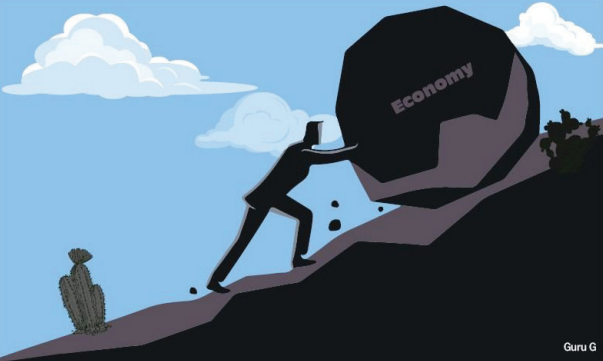
Restart of the economy is a herculean task and cannot be done through an executive order
The stimulus package of Rs 20-lakh-crore, announced by Prime Minister Narendra Modi, raised a lot of expectations. The package reflected Modi’s recognition that lives are as “important” as “livelihoods”. While Kerala was early to restart, all other States have suddenly joined the restart bandwagon. Restarting is a herculean task. The notion that “Restart is like pressing a switch and the economy bulb lights up” needs to be dispelled. This notion is prevalent among some bureaucrats and politicians. Let me start with certain facts.
Fact 1: Lockdown of this size and scale has never been done before and experience is useless
All sizes of enterprises – micro, small, medium or big – have been devastated simultaneously. All countries are impacted. All sectors, save a few essential services, had been shut for extended periods. Supply chains are fully broken. This is unprecedented. So we have to look for new smart solutions.
Fact 2: The government has no expertise to understand business intricacies and how to run a sustainable business
Governments have done a great job during the lockdown. Law and order was very well maintained. Full credit to police, bureaucracy and politicians. Everyone worked as a team to enforce it. Since it is their primary responsibility, the government has acquired enormous strengths over the years to streamline it. But restart is beyond the domain expertise of bureaucrats and government. The government has no expertise to understand business intricacies and running a sustainable business. It is the domain of professionals and entrepreneurs.
On April 14, US President Donald Trump revealed the expert team that will advise him on reopening the economy. He read out the names of nearly 200 corporate chiefs and other notable figures during a news conference at the White House, implying they would act as consultants of sorts. The White House later published a list of leaders who would serve on “Great American Economic Revival Industry Groups”. Even the US government has acknowledged the need for an outside professional group from industry. Indian restart plans too need a professional group.
Fact 3: Whenever we restart the economy, entrepreneurs have to take a calculated risk
The safest time to restart is when new infections die down and the risk of restart of the Covid infection is low. Alternately, we must have a low-cost vaccine cure or the medical treatment for quick recovery. None of the above is likely to happen in the next six months. So the safest way is to wait for six months or more. But by that time, the economy would have been dead. South Africa reported food riots in some parts due to economic shutdown. Hence, whenever we restart the economy fully, we have to take a calculated risk. We have to make tradeoffs. The government must stay the course and not panic into another lockdown.
Fact 4: Due to the extended lockdown, the government capacity to help the poor has been greatly compromised
Government revenues have fallen dramatically, weakening government’s capacity to provide social support or healthcare for the poor. So not only the enterprises but the government will also suffer on a huge scale.
Options for Restart
Is there a framework for restart? Let’s start with acknowledging two MSME ministers. First, we thank Covid for making something happen, which was overdue for decades – making the MSME word fashionable. For a long time, SSI or Small Scale Industry was a liability. Employees, bankers, investors, customers thought poorly of an SSI unit. Suddenly it has changed. Two people deserve credit — Kalraj Mishra, BJP’s first Union Cabinet Minister for MSME, and Nitin Gadkari, current Cabinet Minister for MSME. Mishra was passionate and popularised the word MSME. He is one of the unsung heroes of the MSME sector. Gadkari made the word fashionable with an extraordinary belief in the MSME sector. He made many of the MSME reforms happen.
Pillars for Revival
We need to focus on six pillars for the revival of MSMEs — Liquidity, Reforms, Labour, Supply Chain, Demand and Sustainability. Of these, the most important but unfortunately, the least addressed is sustainability. In the second part of this article, we will discuss these six pillars in detail.
– To be continued.