Beating the graduate glut


Since compensation is based on productivity, the skill ecosystem must focus on performance to get a better premium
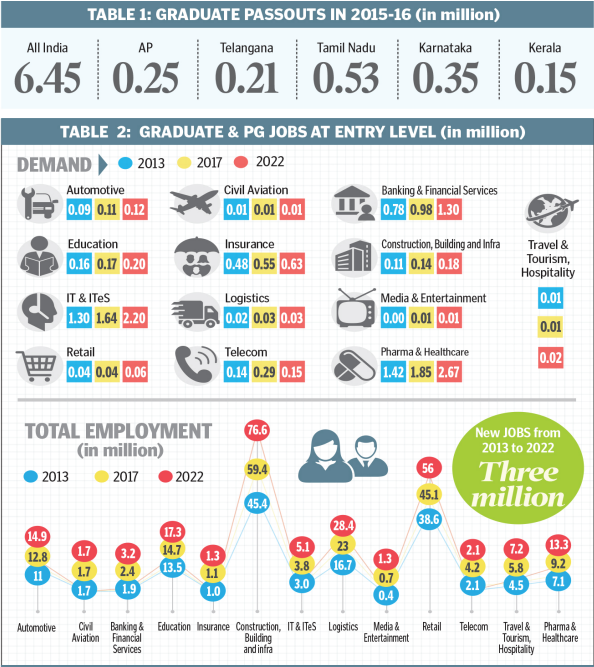
Let’s first look at the supply of graduates (see Table 1). We are producing far more graduates than what we can employ. The HRD Ministry is responsible for improving the Gross Enrolment Ratio (GER) in higher education and they have done this diligently without studying the demand.
The country’s GER increased from 24.5% in 2015-16 to 25.2% in 2016-17. India aims to attain a GER of 30% by 2020. This would mean that our graduate passouts would increase by at least 25% by 2020.
Widening Gap
The second dimension is the demand for graduate jobs. Let’s look at my research data on this, focussing at the entry level (See Table 2). Clearly, these were based on optimistic projections made before 2015 by KPMG for NSDC and other data. Even this report shows that only 3 million jobs would be created during the nine-year period 2013 to 2022 or approximately 0.33 million per year. Compare this against a supply of 6.45 million graduate passouts every year, which will further grow by 25% by 2020.
Unemployment and Employment Terms
The third dimension is employment terms. Among the various employment terms, the most important is salary. A TMI study in Patna a few years ago showed that unemployed graduates wanted Rs 35,000 per month to take up a job in Mumbai. Why? First, lack of correct information about the cost of living. Second, the minimum wages are too low to cover the living costs, even if one were to live in Mumbai at Rs 15,000 per month.
Skill Advantage
Graduates want a wage premium, which is based on a wrong assumption. Across the skill ecosystem, there is a belief that skills mean a wage premium. This is not happening. In Maharashtra, the skill premium between unskilled and semi-skilled is non-existent. In 7 of the 19 industries we studied, the difference is below Rs 10 a day and the skill premium is less than 5%.
Employers are unwilling to pay fair wages because of poor productivity when a person joins the first job. This changes, however, once the individual demonstrates performance and productivity. Job fairs are where they realise they have little hope. In a job fair we conducted in Deoria last year, several thousand graduates competed for just a few jobs.
The Solution
Supply Side
- Stop focus on increasing GER: HRD Ministry must align supply to demand and shift focus to quality. Allow unviable colleges and courses to shut down.
- Increase fee structure: Required for better quality of teaching infrastructure, especially in non-engineering courses.
- Higher tuition fee: This is a must to dissuade anyone joining a graduate college without the aptitude. Provide scholarships instead.
- Encourage ‘learn while you earn’: Subsidise and promote Open University education.
- Introduce job counselling courses: Share the reality of the job market with students and parents.
Demand Side
- Support MSMEs: Only MSMEs can provide employment to the masses. Provide incentives like skill wage subsidies to encourage graduates to join this sector.
- Export experienced manpower: Replace them with skill-certified fresh manpower.
Employment Terms
- Revise minimum wages: Necessary for semi-skilled workers and graduates.
- Set up skill hostels: Located at job centres so graduates can stay at minimum cost and do not go ‘out of pocket’ while working in their first job.