Why India Needs Frontline Performance Outsourcing (FPO)

Frontline Performance Outsourcing: The Next Frontier in Workforce Productivity
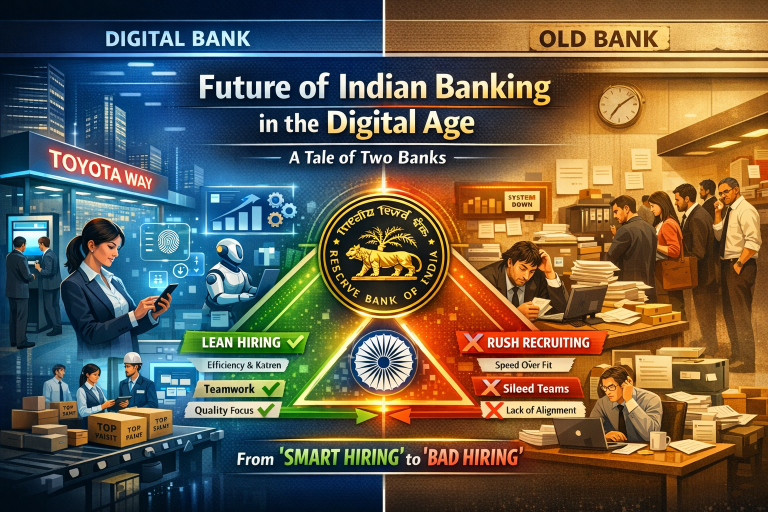
In the 1980s, Toyota and General Motors jointly operated the NUMMI plant in California. What surprised observers was not the machinery, but the results. The same workers who had performed poorly under the old GM management suddenly became highly productive under Toyota’s system. Absenteeism dropped sharply and productivity rose dramatically.
The workers had not changed. The difference was the system. Toyota created a structured performance system based on clear tasks, daily feedback loops, peer learning, and continuous improvement. NUMMI demonstrated a powerful principle: productivity is not just about people, training, or incentives — it is about the system within which people operate.
This insight is equally relevant to India’s frontline workforce today.
The Frontline Productivity Problem
India’s frontline workforce powers industries such as banking, insurance, retail, telecom, logistics, and consumer services. Yet despite decades of investment in hiring, training, and supervision, frontline productivity remains deeply inconsistent.
Companies continue to experiment with recruitment filters, training programs, incentive structures, and learning platforms. However, the outcomes remain the same: uneven performance, high early attrition, and heavy dependence on supervisors to drive results.
This suggests a deeper problem. The current model of managing frontline performance itself is broken.
Evidence from QP Centre of Excellence
Research conducted by the Quanta People Centre of Excellence (QP COE) across multiple sectors indicates that six out of seven key indicators point to structural failure in existing frontline management models.
- Performance variation: Extreme variation between employees performing the same role
- Infant attrition: High early-stage attrition especially within the first 90 days
- Training impact: Weak linkage between training programs and actual productivity outcomes
- Supervisor dependence: Excessive dependence on supervisors to push performance
- Lead indicators: Lack of reliable lead indicators for measuring productivity
- Critical task mastery: Absence of scientific measurement of critical task mastery
These signals point to a simple reality: frontline performance is still managed through intuition and fragmented interventions rather than through a scientific system.
The Emergence of Frontline Performance Outsourcing (FPO)
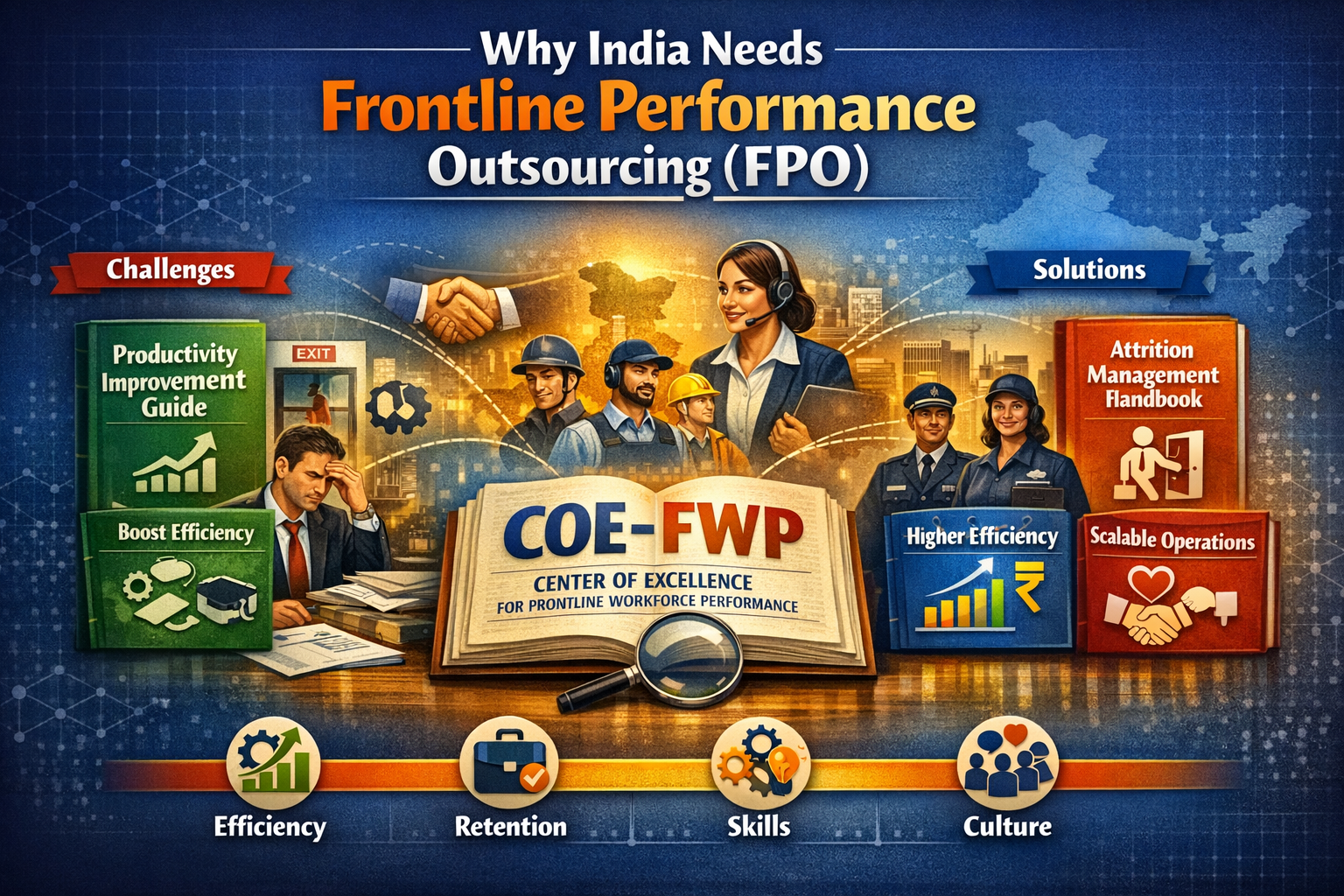
Just as companies outsource payroll, IT infrastructure, recruitment, and customer service, the next frontier is outsourcing the system for frontline productivity management.
This emerging model can be called Frontline Performance Outsourcing (FPO).
FPO is fundamentally different from traditional outsourcing:
- It is not staffing
- It is not training
- It is not HR consulting
Instead, FPO is the outsourcing of the entire performance system that drives frontline productivity and retention.
Building Blocks of Performance Productivity Outsourcing (PPO)
- 1. Identification of critical tasks that drive productivity
- 2. Measurement of daily lead indicators of performance
- 3. Platforms capturing real-time behavioural and productivity data
- 4. Peer learning and behavioural reinforcement loops
- 5. Supervisor productivity support systems
- 6. Cohort analytics identifying attrition risks and performance gaps
- 7. AI-driven digital platforms enabling personalised performance coaching
Performance is fundamentally an individual journey. Each frontline employee has different strengths, gaps, learning speeds, and behavioural patterns. Therefore productivity improvement cannot rely on one-size-fits-all programs.
It requires AI-enabled digital systems that customise performance coaching for every frontline employee and supervisor.
QP System Architecture for Frontline Performance Outsourcing
The Quanta People platform stack functions as an integrated operating system for frontline productivity management.
- SPARC – Smart Performance & Retention Coach (AI coaching layer)
- CLAN – Peer learning and behavioural reinforcement engine
- CTM Workbench – Critical task mastery measurement framework
- DARTS – Daily activity and productivity tracking system
- LENSE – Hiring analytics and role-fit engine
This layered architecture captures behaviour, measures critical task mastery, enables peer learning loops, and provides AI-driven performance coaching.
The QP FPO Model
Together, these platforms create a complete operating system for frontline productivity management.
Conclusion
Quanta People represents India’s first Frontline Performance Outsourcing startup — a company built around the science, systems, and AI required to transform frontline productivity at scale.
As organisations face increasing pressure to improve productivity while controlling workforce costs, the shift from internal performance management to outsourced performance systems may become one of the most important workforce transformations of the coming decade.