Why RBI Needs to set up a Productivity and Attrition Task Force (PAT) for Frontline Banking and Financial Services

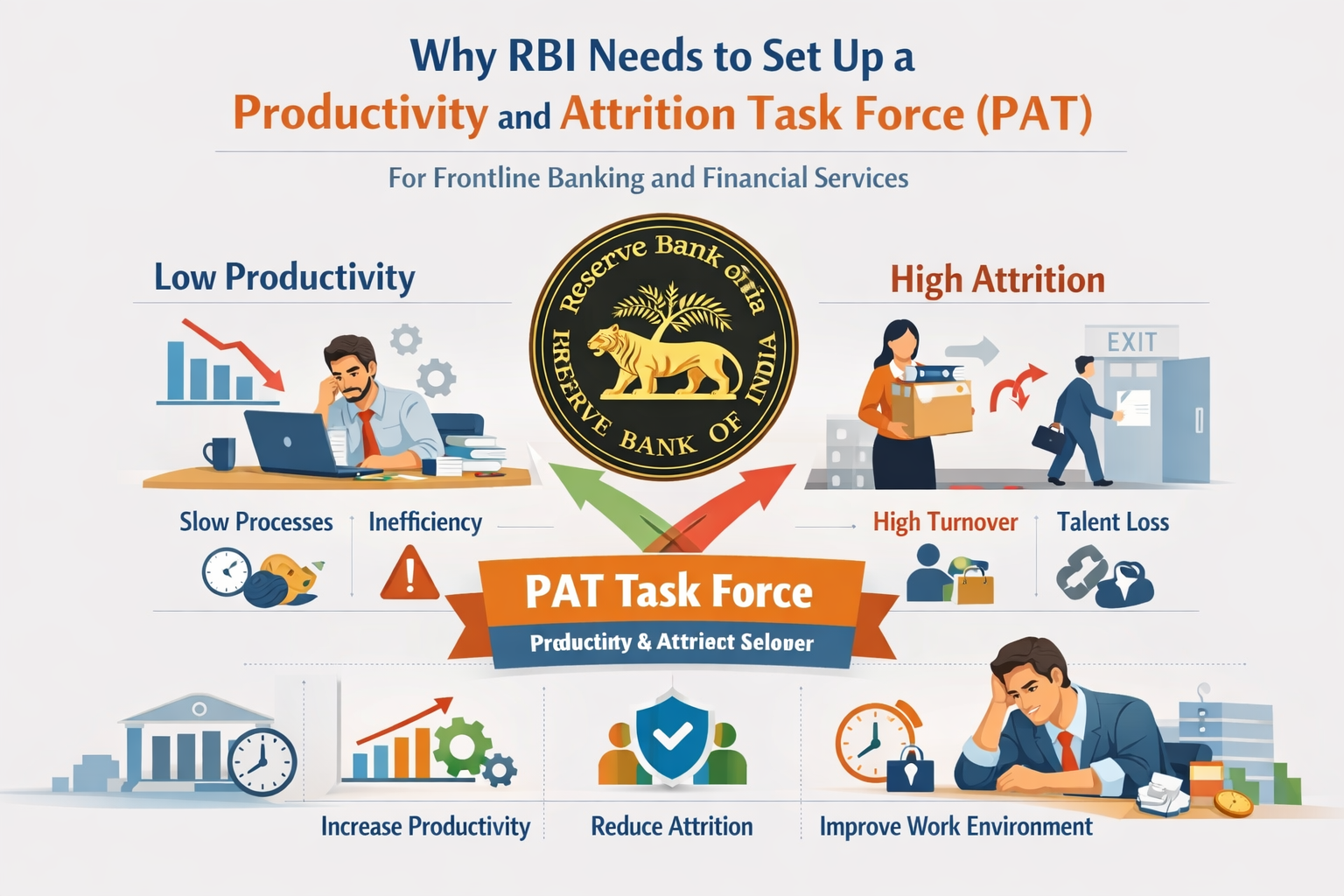
India’s banking and financial services (BFS) sector depends on its frontline workforce for sales, customer service, and operations. Yet attrition—especially infant attrition within the first 3–6 months—remains alarmingly high, eroding productivity, customer trust, and increasing operating costs. The Reserve Bank of India (RBI) has acknowledged attrition concerns but requires a dedicated mechanism to measure and address them. A Productivity and Attrition Task Force (PAT) is urgently needed to standardize reporting, link wages to productivity, and recommend sustainable workforce practices. Without timely action, BFS institutions risk systemic inefficiencies, rising costs, and higher operating risks.
Introduction: The Missing Link in India’s Financial Stability
India’s banking and financial services (BFS) sector is one of the largest employers in the country, especially for frontline roles in sales, customer support and in branch operations with over 1 million workforce. These are the people who open current and savings accounts, sell loans, collect repayments, handle grievances, and provide the everyday human interface that keeps banks credible and trustworthy in the eyes of millions of customers. Yet, despite their importance, frontline employees are the weakest link in the BFS value chain. The Reserve Bank of India (RBI) has repeatedly flagged high attrition as a risk, but the scale, nature, and systemic consequences of this problem remain underexplored. The truth is stark: frontline attrition—particularly infant attrition within the first 90 to 180 days of employment—has reached unsustainable levels. This threatens not just institutional performance but also India’s employment agenda. It is time the RBI steps in decisively by creating a Productivity and Attrition Task Force (PAT) dedicated to the frontline workforce in BFS.
The Frontline in BFS: Silent Drivers of Growth
Frontline roles in BFS are far more than entry-level jobs. They form the first point of contact for customers—whether it is convincing someone to open their first savings account, processing a home loan, recovering overdue EMIs, or solving digital transaction disputes. In sales, frontliners directly influence revenue growth. In customer support, they shape trust, complaint resolution, and long-term retention. In operations, they ensure compliance and transaction accuracy. Without this human engine, banks cannot scale outreach, service new geographies, or deepen financial penetration. Frontline efficiency is therefore national productivity in disguise.
Attrition: A Chronic Challenge Flagged by RBI
RBI’s Report on Trend and Progress of Banking in India 2023–24 regarding attrition: reports that employee attrition in private sector banks and small finance banks (SFBs) has risen sharply to around 25%, posing significant operational risks. These include disruptions to customer services, loss of institutional knowledge, and increased recruitment costs. Importantly, RBI emphasizes that reducing attrition is not merely an HR issue but a strategic imperative for banks.
Boards of banks are being advised to monitor workforce metrics alongside credit quality and NPAs. However, current reporting and supervision frameworks barely scratch the surface. Attrition is treated as an HR statistic rather than a systemic risk. RBI highlights the problem but has yet to institutionalize mechanisms to measure, monitor, and mitigate frontline attrition as a financial stability issue.
The Data: Attrition in BFS
Industry studies paint a worrying picture: BFS frontline annual attrition rates range between 35% and 50 %, among the highest across industries. In sales-heavy functions (loans, insurance, cards), attrition often exceeds 50%. Customer service and collections show only marginally better figures. But the true crisis is hidden inside these averages. A large chunk of exits happens in the first 3–6 months of employment—a stage when companies have already sunk training and onboarding costs but have not yet recovered productivity from the hire. This infant attrition is the silent killer of BFS efficiency.
Infant Attrition: The Unreported Crisis
Unlike gross attrition data, infant attrition is not systematically reported to RBI. Banks and NBFCs disclose headcount churn but do not break it down by tenure bands. Ground-level evidence suggests that 50% of new frontline hires in BFS leave within 180 days. These are people who never reach full productivity, never stabilize in the organization, and never generate returns on salary and hiring and training costs. The lack of standardized reporting means policymakers underestimate the drag this places on productivity, credit delivery, and customer experience. Without RBI mandating disclosures, infant attrition will remain invisible in official statistics while silently eroding sectoral efficiency.
The Productivity–Attrition Link
Attrition is not just about replacing headcount. It directly reduces productivity in three ways:
- 1. Lost Learning Curve – Every time a new hire quits early, their partial training and initial customer exposure vanish with them.
- 2. Team Disruption – High turnover creates unstable branch teams, which affects sales performance and service consistency.
- 3. Managerial Overload – Supervisors spend disproportionate time on recruitment and firefighting instead of mentoring or business development.
High attrition translates into low per-head productivity, undermining return on assets and service quality.
On the other hand, data shows that once a new employee crosses 50% of target, attrition drops by a factor of 3
Productivity, Wages, and the Stagnation Trap
Frontline productivity has a direct bearing on wages. Employers argue that wages cannot rise because productivity remains low. Yet productivity remains low because attrition erodes continuity and mastery. The result is a vicious cycle: stagnant wages (₹18,000–₹25,000 per month in many BFS frontline roles), rising cost of living in urban centers, and unsustainable migration for semi-urban youth who move to cities but cannot make ends meet. This leads to disillusionment and frustration amongst the Indian youth and faster exits—reinforcing the attrition trap.
Why RBI Must Act: Beyond HR Metrics to Systemic Risk
Frontline attrition is not an isolated HR problem. It is a systemic issue with multiple spillovers:
- Financial inclusion risk – Unstable field teams mean weaker outreach in underserved geographies.
- Credit quality risk – Poorly trained or transient staff often drive mis-selling and weak collections.
- Customer trust risk – High turnover leads to inconsistent service, eroding faith in formal finance.
- Economic risk – Wage stagnation and urban migration stress create broader social vulnerabilities.
As the central bank tasked with financial stability, RBI cannot leave this problem to HR departments. It needs a dedicated Productivity and Attrition Task Force (PAT) to frame a national-level response.
The Mandate of PAT
The proposed PAT should be a specialized task force constituted by RBI, with the following mandate:
- 1. Standardize industry-wide reporting of attrition by tenure bands.
- 2. Link attrition reporting with productivity and credit performance indicators.
- 3. Conduct a systematic study of wage-productivity – vintage linkages in frontline BFS roles.
- 4. Recommend wage correction frameworks tied to productivity improvements.
- 5. Define minimum standards for hiring , induction, training, and infant -attrition.
- 6. Assess migration sustainability
- 7. Provide regular updates to RBI and align with financial inclusion goals.
Who Should Be in PAT
The PAT must be multi-stakeholder in composition to ensure credibility and actionable outcomes. Suggested members: RBI representatives (Department of Supervision, HR & financial inclusion), banking & NBFC HR leaders, industry bodies like IBA and FIDC, academic experts in labor economics, employee representatives, and independent experts in workforce analytics. Such a cross-functional design would ensure PAT recommendations are not just regulatory mandates but practical playbooks for banks.
The Urgency: Why Delay is Dangerous
The BFS frontline is in the midst of a perfect storm: attrition at historic highs, wages stagnant while inflation climbs, customer expectations shifting to digital-first but still human-reliant, and AI/automation disrupting traditional sales and service roles Above all stress on retail assets and collection challenges.
If RBI delays action, the consequences will be severe: higher credit costs due to weaker collections, more mis-selling scandals, slower financial inclusion, and greater youth disillusionment with BFS careers. Every quarter of delay deepens the structural hole.
Conclusion: A Call to Action
The RBI has been visionary in anticipating systemic risks in credit, fintech, and NBFC regulation. It now needs to show the same foresight in workforce sustainability. By setting up a Productivity and Attrition Task Force (PAT), RBI can signal that human capital is as critical as financial capital in ensuring sectoral stability. The frontline workforce of India’s BFS sector is too important to be left at the mercy of fragmented HR practices. The future of financial inclusion, customer trust, and banking productivity depends on urgent, coordinated action. PAT is the way forward—and the time is now.
T Muralidharan
Chairman TMI group