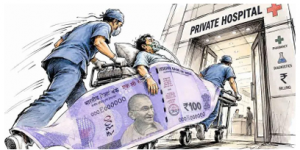
When patients become dependent on the hospital, can they also become commercially captive?
Private healthcare in India has become one of the most emotionally and financially draining experiences for middle-class and lower-middleclass families. Across the country, households routinely exhaust savings, borrow from relatives, pledge jewellery, liquidate investments, or even sell assets to pay hospital bills. Medical emergencies remain among the fastest paths from financial stability to financial distress This is not a perception. It is a widely acknowledged reality and frequently reported in newspapers. “Hyderabad consumer commission orders hospital to compensate Rs 3 lakh for overcharging during Covid” was the headline in a leading English daily. Even as insurance coverage expands, out-of-pocket expenditure beyond insurance claims remains the dominant burden. Private hospitals— especially tertiary and super speciality centres—are respected for quality care, yet feared for open-ended and often unpredictable bills. That is why the recent Competition Commission of India (CCI) order involving 12 major Delhi NCR hospitals is not merely another legal decision.
The Case
The CCI closed a decade-long investigation into allegations of overcharging and abuse of market dominance against 12 major private hospitals in Delhi-NCR. The watchdog dismissed the charges, concluding there was insufficient evidence to prove the hospitals had engaged in “excessive” and “unfair” pricing.
This order strikes a raw public nerve. It raises two key questions: When a patient enters a hospital, does s/ he remain a patient — or become a captive customer? Can the hospital overcharge an in-patient because s/he is captive?
Captive Ecosystem
A patient enters a hospital expecting care, professional judgment and trust – not a commercial marketplace where crucial purchase decisions are made on his behalf, without meaningful consultation. Yet once admitted:
- Medicines must be bought from the hospital pharmacy
- Diagnostics are routed through the hospital’s labs and must be redone
- Consumables are used without discussion of brands or costs
- Tests are often repeated even when valid external reports exist
- Families, under emotional pressure, rarely have the information or ability to question decisions
Thus, the CCI case is not about high bills alone. It concerns commercial behaviour within a medically captive environment.
Why this Matters
The Office of the Director General (DG), the investigative arm of the CCI, conducted the fact-finding. This is crucial: the conclusions were not drawn by a private complainant but by a statutory authority. The DG found that admitted in-patients paid more than out-patients for medicines, consumables, diagnostics and services, and that once admitted, patients had little practical ability to procure these from outside sources. Each hospital became a closed commercial ecosystem. Before admission, a patient may theoretically be in a competitive market. After admission, he is not. Once admitted, the hospital controls:
- procurement
- urgency
- brand selection
- repeat testing
- and the entire decision-making environment
Thus, the DG’s “lock in” finding is central – not just because choice is reduced, but because reduced choice creates commercial disadvantage. The investigation reportedly documented differential pricing patterns, raising serious questions of fairness and patient rights. These are not allegations; they are independently established facts.
CCI’s Narrower Legal View
The CCI appears to have accepted that admitted patients rely on internal hospital ecosystems. Yet it concluded that this does not constitute actionable abuse under competition law. Let’s examine the CCI rationale.
One pillar of CCI’s reasoning is that patients can choose hospitals before admission. This is theoretically true but practically weak. Do hospitals disclose upfront: that inpatients lose access to OPD discounts? that medicines may be billed at MRP despite available discounts? that external diagnostics may not be accepted? that estimates are only indicative and may escalate significantly? In most cases, no. A choice based on incomplete information is not an informed choice.
The Aftermarket Question
The DG recommended treating each hospital’s in-patient ecosystem as a separate “aftermarket” or relevant market. The CCI rejected this, taking a broader view of super-speciality hospitals. Legally, that position is defensible. Practically, it is incomplete. A recovering patient, an ICU patient, a post-surgical patient — none of them is participating in any competitive market. They are functionally dependent on one hospital. Before admission, the patient chooses the hospital. After admission, the hospital chooses everything for the patient. This is not an ordinary consumer choice; it is dependency.
Differential Pricing Problem
The CCI noted that higher prices alone do not prove abuse. That is correct. Hospitals incur legitimate costs: infrastructure, staffing, compliance, emergency readiness, and inventory management. But the sharper question is: If the same hospital uses the same pharmacy, staff, inventory, and supply chain, why do inpatients systematically lose access to discounts available to outpatients? If OPD patients get lower-priced medicines, discounted diagnostics, and more competitive consumable rates, why are admitted patients denied the same? This is not simply high pricing – it is differential pricing within a captive environment. Logically, inpatients – who bring more predictable volume – should receive lower pricing. Yet the opposite happens.
Diagnostics: Incomplete Explanation
The CCI argued that hospital diagnostics cannot be directly compared with standalone labs due to:
- emergency readiness
- clinical integration
- faster turnaround
- 24×7 capability
These points have merit. But they do not justify opaque pricing. If emergency diagnostics require premiums, those premiums should be transparently disclosed. Routine daytime diagnostics cannot carry steep mark-ups merely by invoking 24-hour readiness, especially when many imaging facilities are not fully operational at night. The real issue is not the existence of a premium, but whether the premium is transparent, proportionate and fair. The CCI may have adopted a narrow legal interpretation, but the public policy question remains urgent. Healthcare affordability in India is now a national household crisis. This is not an extraordinary complaint. It reflects a pattern that countless families recognise instantly.
What Should Happen Next
Appellate Review
Complainants should seriously consider appellate options. The DG’s findings provide a substantial factual basis for re-examination of whether competition law was too narrowly applied to a captive medical environment.
Wider Policy and Ethical Review
This issue extends beyond competition law. It touches: consumer protection, medical ethics, informed consent, pricing transparency, and healthcare governance. The Central Consumer Protection Authority should examine unfair trade practices. The National Medical Commission should review ethical norms around commercial conduct. The Ministry of Health should consider mandatory transparency standards for billing and procurement. Patient rights groups should collect systematic evidence. Journalists should investigate pricing differences between OPD and inpatient care.
The Larger Principle
Hospitals are not ordinary businesses. Healthcare operates around trust, vulnerability and information asymmetry. Standards of transparency must therefore be higher, not lower. A patient is not a shopper. And an admitted patient is certainly denied free consumer status. If medically dependent patients can become commercially captive customers, the issue is far larger than competition law. It becomes a question of ethics, governance, patient dignity, and public trust.
(The author is Founder Chairman, TMI Group and Quanta People)